
Character
The Character of Pulteney Grammar School
Established by people who sought opportunity and valued the power of education, Pulteney began before the introduction of government schooling. In 1847, a small, functional schoolhouse on Pulteney Street welcomed its first 50 students and laid the foundation for what would become one of Adelaide’s distinguished independent schools. While its beginnings were humble, its ambition has always been forward-looking. Today, Pulteney stands at the forefront of contemporary education, shaped by innovative learning spaces, tailored teaching practices, and a commitment to preparing students for the world beyond the classroom.
The School’s central location places it within the vibrant heart of Adelaide, enabling meaningful partnerships with businesses, universities, cultural institutions and civic organisations. These collaborations enrich the curriculum and extend learning beyond school grounds—supporting hands-on, experiential learning and nurturing entrepreneurial, social and technical skills in students of all ages.
Pulteney staff and students are proud of their School. A genuine sense of camaraderie flows through all year levels, where students are valued contributors to their learning environments and encouraged to take on leadership roles from an early age. From the start of their learning journey, students are provided with support, guidance and the resources needed to become confident and capable learners. They are encouraged to take ownership of their learning pathways, build meaningful relationships, and participate fully in all aspects of Pulteney life.
This holistic educational philosophy is deeply connected to the School’s Anglican heritage. Since its founding, Pulteney has been shaped by values that honour tradition while embracing innovation. Anglican principles guide compassionate practice, foster a spirit of service and inform the School’s belief that every individual is inherently valuable and worthy of dignity and respect. Diversity is embraced, and students and staff are encouraged to express themselves openly within a culture grounded in acceptance and empathy.
These values are lived daily. Hard work, intellectual rigour and openness to ideas underpin the teaching and learning environment. Weekly Chapel services, student-led celebrations, assemblies and wellbeing initiatives foster connection, reflection and personal growth. The School’s pastoral structures and Wellbeing Team—including the Chaplain, psychologist, nurses and counsellors—support students academically, socially and emotionally, ensuring every learner feels known and cared for.
Service is central to the character of Pulteney. A commitment to social justice is evident in the meaningful ways students contribute to local, national, and global communities. Through service learning, community partnerships, fundraising, and everyday acts of kindness, Pulteney students learn to lead with integrity, compassion and courage.
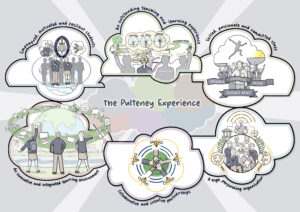
Today, The Pulteney Experience remains a defining feature of the School: a complete, connected education characterised by rich learning, strong relationships, and memories and friendships that last a lifetime. Pulteney is more than a place of study—it is a community of belonging, a place where young people discover who they are, what they can achieve and how they can contribute to the world with purpose.

Pulteney Grammar School: One of Adelaide’s Oldest Independent Schools
Founded in 1847 with just 27 students, Pulteney Grammar School began as the Pulteney Street School. From the outset, the school welcomed both boys and girls, a progressive move for the times. Its first Principal, Mr Miller, single-handedly taught all classes until the school’s rapid growth demanded additional support. Subjects such as writing, mental arithmetic, geography and grammar formed the foundation of its early curriculum.
In 1861, the education of girls continued under the guidance of Elizabeth Moore, who led the girls’ school until her departure in 1884, after which girls’ education ceased for several decades. Meanwhile, Pulteney’s identity continued to evolve. In 1870, the Trustees introduced religious instruction four mornings a week, and the following year, the Board of Education declared Pulteney Street School a denominational institution. Government funding was withdrawn, and the School transitioned to independent status, beginning its longstanding position as one of South Australia’s prominent independent schools.
The early 20th century brought great challenges. The Boer War and both World Wars claimed the lives of over 130 Old Scholars, leaving a lasting impact on the School community. During this period, Pulteney operated as a boys’ school and focused on delivering a practical education. Under the leadership of Headmaster William Nicholls (1901–1942), the School underwent significant transformation, including a move to its current South Terrace location and a name change to Pulteney Grammar School. It was during these years that values of resilience, service, and unity became deeply embedded in the school’s character.
The second half of the 20th century saw Pulteney continue to modernise under the guidance of visionary leaders such as Canon Ray and Mr Jock Mackinnon. New buildings and facilities were developed, including the School’s first gymnasium and library, upgraded science classrooms, and expanded sporting amenities. These advances were made possible through a strong spirit of community, with parents, Old Scholars, and staff uniting to support the School during times of broader social and economic upheaval.
A defining milestone came in 1999, when Pulteney returned to its coeducational roots, welcoming 70 girls to the campus. That same year, Pulteney also stepped into the digital age with the arrival of fifty iMac computers, setting the stage for innovation in teaching and learning.
Today, Pulteney Grammar School is one of Adelaide’s oldest and most respected independent schools, offering a dynamic ELC to Year 12 education. Our enduring commitment to innovation, personalised learning, and academic excellence has ensured the School continues to thrive, shaped by its people, guided by its values, and strengthened by a proud tradition of community and compassion.